
AI Video Orchestration Platform
From structured data to photorealistic video
AI Video Orchestration Platform
AI Video Orchestration Platform is a video production system that connects AI-generated content, speech synthesis, digital performers and photorealistic graphics within a single automated workflow.
A person completing a form, an external application or an AI agent can initiate a new video. The system turns a structured production specification into scenes, actor performances and camera sequences, then renders the final output.
The project covers software architecture, backend orchestration, AI and speech-service integration, animation systems and the implementation of the rendering pipeline.

THE ENGINEERING CHALLENGE
Automating this workflow requires several technologies to agree on the same production: the script, its delivery, the performers, the scenes and the camera direction.
The central engineering challenge was to connect probabilistic AI models with software that explicitly controls how the video is assembled. Creative inputs can come from AI or a human, while scene construction and execution follow defined production instructions.
HOW THE SYSTEM WORKS
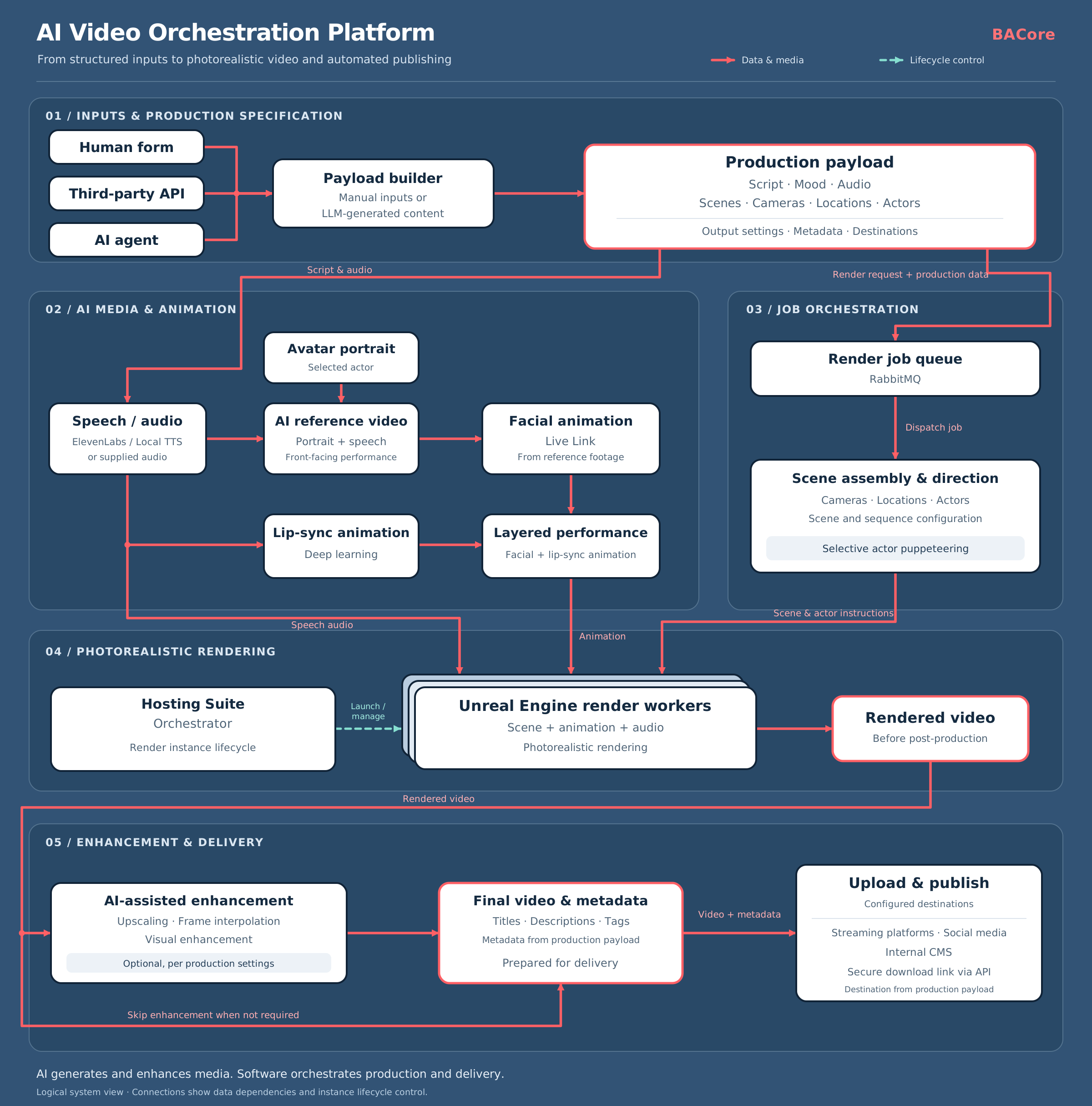
1. Start from a form, an API or an agent
Video requests can originate from a manually completed form, a third-party integration calling an API, or an AI agent. These entry points feed the same production pipeline, allowing video creation to become part of a wider software workflow.
2. Define the production as structured data
Manual inputs, AI-generated content or a combination of both form a structured payload describing the requested video. It specifies the script, mood, audio, scenes, camera angles, locations and actors.
This payload connects the content-generation process to the software responsible for constructing and rendering the production.
3. Prepare the voice performance
The workflow supports supplied audio and speech generated through the ElevenLabs API or a local text-to-speech system. The resulting audio is used in the video and provides an input to the facial-animation and lip-sync stages.
4. Generate facial performance and lip sync
A separate AI model uses an avatar portrait and its audio to generate a front-facing performance video. This video serves as a reference input for driving the 3D actor’s facial expressions through a Live Link-based workflow.
A deep-learning lip-sync system adds another animation layer driven by the audio. These stages contribute complementary information to the actor’s final performance.
5. Direct the actors and assemble the scenes
Software uses the production payload to select actors, locations, scenes and camera angles. Selective puppeteering provides additional control over how the actors perform, combining generated animation with explicitly directed behaviour.
6. Render the finished video
The resulting performances are applied to digital actors within photorealistic 3D scenes. Unreal Engine renders the final video using the configured scene and camera instructions. The generated reference footage is an intermediate animation input; the finished production is rendered from the 3D environment.
7. Enhance and prepare the rendered output
After rendering, the footage can pass through AI-assisted upscaling, frame interpolation and visual-enhancement stages. This produces high-resolution delivery formats without requiring every frame to be rendered natively at the final resolution.
8. Upload and Publish
The finalised video asset is automatically prepared for distribution based on the original structured payload. The system compiles the necessary metadata—such as auto-generated titles, descriptions, and tags—and routes the file to its designated destination. Whether publishing directly to streaming platforms and social media, uploading to an internal CMS, or returning a secure download link via API, this final step completes the automated lifecycle without requiring manual human intervention.
AI GENERATION WITHIN A CONTROLLED PRODUCTION PIPELINE
The architecture brings together two complementary kinds of computation. AI models generate variable content, speech and performance inputs. Conventional software defines the production structure, connects the components and controls scene assembly, actor direction and rendering.
COMPUTE AND COST EFFICIENCY THROUGH HYBRID GENERATION
Generating full-motion video entirely through AI models is computationally expensive and unpredictable. By separating the creative generation (scripts, voice, and facial performance) from the physical scene rendering (3D environments, camera tracking, and lighting), this architecture dramatically reduces compute overhead.
The system strategically allocates AI tokens only where they add the most value—human-like performance and narrative generation. The heavy lifting of world-building and scene assembly is offloaded to highly optimized, deterministic software (Unreal Engine).
This hybrid approach not only guarantees explicit control over the final output but also drastically lowers the cost per minute of video. By leveraging procedural, non-AI systems for the bulk of the visual rendering, the platform maximizes production efficiency, allowing organizations to scale their video output without scaling their AI API costs.
WHAT THE PROJECT DELIVERED
The result is a programmable video-production system connecting external triggers, structured data, AI services and photorealistic rendering.
It supports human-led and automated requests, layered facial animation and lip sync, and direct control over actor performances. It demonstrates the engineering needed to turn several specialised technologies into a complete working application.
This project brings together BACore’s work in applied AI, backend architecture, API integration, workflow orchestration and hands-on software implementation.
TECHNICAL FOUNDATION
C++ · C#/.NET · REST APIs · RabbitMQ · Structured production payloads · LLM integration · ElevenLabs API · Local text-to-speech · AI-generated performance reference · Deep-learning lip sync · Live Link · Unreal Engine