
ENGINEERING / SOFTWARE ARCHITECTURE
Software architecture.
From decisions to production.
We design, build and evolve software systems around business requirements, integration constraints and operational needs. Architecture, hands-on development and delivery stay connected throughout the project.
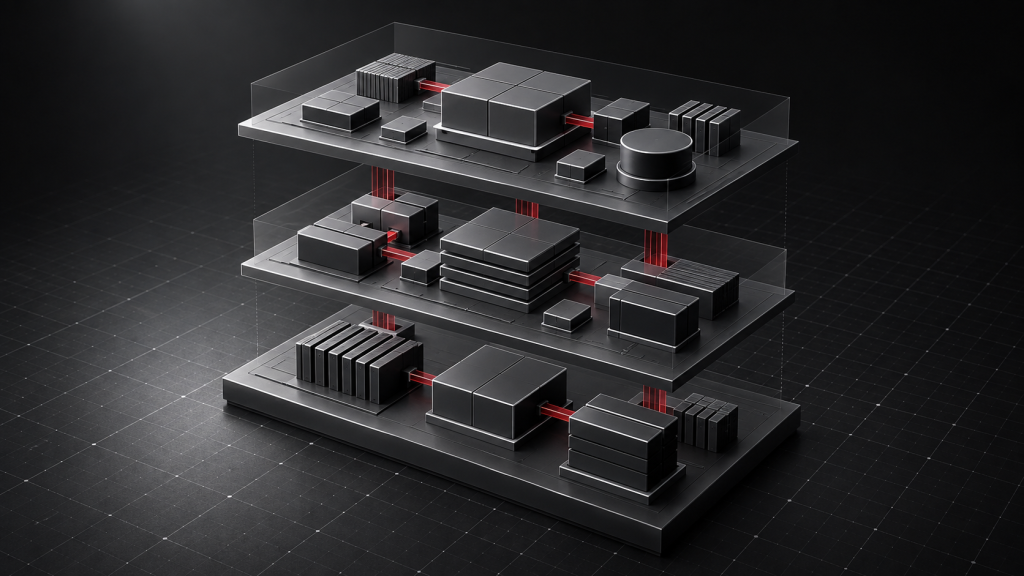
Clear boundaries. Explicit interfaces. Working systems.
WHEN WE CAN HELP
Make the next technical move with a clear plan.
01 / NEW PRODUCTS
Build a new product
Turn a business process or product idea into a system map, a delivery plan and working software.
02 / EXISTING SYSTEMS
Modernise with continuity
Map dependencies and replace constrained components in stages, with migration and rollback considered from the start.
03 / INTEGRATION
Connect complex systems
Bring applications, APIs, AI services and device data into a coherent workflow with clear responsibilities.
04 / PERFORMANCE
Find the constraint
Investigate slow paths, fragile dependencies and operational blind spots before choosing what needs to change.
ARCHITECTURAL DECISIONS
Choose the structure the system needs.
We make the trade-offs explicit: what a decision enables, what it costs to operate and what would justify changing it.
Boundaries & ownership
Define component responsibilities, data ownership, tenant boundaries and access rules. Keep changes local where possible.
Interfaces & execution
Specify API contracts and choose between direct calls, events and background jobs. Account for timeouts, retries and duplicate work.
Deployment & operation
Match deployment to the environment, delivery cadence and team. Design logs, metrics and failure visibility alongside the application.
Evolution & migration
Plan how data, integrations and clients move between versions. Document assumptions and validate the riskiest ones in code.
A PRACTICAL STARTING POINT
A modular application may be the right architecture.
Separate services become useful when independent scaling, deployment, ownership or isolation justify the additional operational work. We choose that boundary deliberately.
ARCHITECTURE IN PRACTICE / 01
Hosting Suite
Server lifecycle, backend communication and operational control.
THE PROBLEM
Server instances need to be provisioned, connected to backend functionality and made visible to the people operating the system.
WHAT BACORE BUILT
An orchestrator, a ServerLink integration component, backend APIs and a control interface. The implementation connects instance management with service communication and operational visibility.
THE ARCHITECTURAL DECISION
Separate instance lifecycle from application features. Use explicit communication interfaces—BACore’s RPC protocol over WebSockets—between server-side components and backend services. Support dedicated and on-premises environments.
SIMPLIFIED COMPONENT MAP
CONTROL
Operational dashboard
Server management · metrics · logs
↑↓ management & visibility
COORDINATION
Orchestrator
Deployment and instance lifecycle
↓ provision & manage
EXECUTION
Server instances + ServerLink
Application execution and server-side integration
↑↓ RPC over WebSockets
SERVICES
Backend APIs
Shared application functionality
Conceptual view of the documented components; individual features and deployment topology are omitted.
ARCHITECTURE IN PRACTICE / 02
AI Video Orchestration Platform
One production specification connecting specialised AI and software components.
SIMPLIFIED PRODUCTION FLOW
INPUT
Form · API · AI agent
A request enters the same production workflow
↓ structured production payload
SPECIFICATION
Script · audio · actors · scenes
Mood, locations and camera instructions
↓ generate & prepare
AI SERVICES
Voice & performance inputs
Speech, facial reference and lip-sync layers
↓ assemble & render
OUTPUT
Scene construction → final video
Software applies the specification to the production
Conceptual flow, grouped for readability. AI-generated reference footage is an intermediate input to the final rendering stage.
THE PROBLEM
Content generation, speech, performance and rendering must agree on the same production while accepting requests from people and external systems.
WHAT BACORE BUILT
The architecture, backend orchestration, service integrations and production pipeline connecting structured requests to assembled scenes and rendered video.
THE ARCHITECTURAL DECISION
Use a shared production payload to connect variable AI outputs with explicitly controlled scene assembly. Separate generation, integration and rendering responsibilities while keeping them part of one workflow.
FULL DEVELOPMENT CYCLE
Decisions become code. Code provides feedback.
The depth of each stage follows the project. We agree the outputs and responsibilities at the start, then refine the architecture as implementation and operation reveal more.
01
Understand
Requirements, constraints and an initial system map.
02
Design
Boundaries, contracts and documented decisions.
03
Implement
Working increments, integrations and migration code.
04
Validate
Tests and checks against the agreed requirements.
05
Evolve
Operational feedback, documentation and next decisions.
Understand → Design → Implement → Validate → Evolve
The handover can include system and data-flow diagrams, architecture decision records, API contracts, a delivery or migration plan, source code and operational documentation. Deliverables are agreed to fit the engagement.
TECHNICAL RESPONSIBILITY
Architecture with hands-on engineering.

Javier Sevilla
CTO | SOFTWARE ARCHITECT | LEAD DEVELOPER
Technical direction connected to hands-on programming, integration and delivery. Javier carries architectural decisions into the implementation.

Joana Manzano CCIE #58575
CLOUD, NETWORK & SECURITY ARCHITECTURE
Cloud, network and security architecture, with certifications spanning AWS, Microsoft Azure, Google Cloud and Cisco.
LET’S DEFINE THE NEXT STEP
What does your system need to do?
Bring your requirements, an existing system or a difficult integration. We can define the architecture, implementation scope and route to production together.